
Watching the dramatic flight footage from McGregor, you might assume the airborne Tesla Roadster is the exact machine you can order today. That common assumption skips the reality. The vehicle hovering in those viral clips is an experimental, single-seat Rocket prototype legally barred from public highways. You saw the thruster plumes and the ceiling run at SpaceX's McGregor facility on October 15, 2026, and the engineering spectacle was undeniable. Yet separating theatrical demonstration stunts from what reaches customer garages requires examining the fine print.
Source: Tesla, Oct 16, 2026 (opens in a new tab) · Reuters, Oct 15, 2026 (opens in a new tab)
Tesla demonstrated cold-gas thruster propulsion—rocket thrusters releasing pressurized gas without combustion—alongside vacuum fan downforce at McGregor, yet quietly split the car into three tiers. Fans watching since 2017 deserve an honest breakdown of the hardware, numbers, and regulatory barriers. Behind the cinematic smoke lies a complex story of redefined engineering goals, sharp trade-offs, and an unresolved production horizon.
Source: Tesla, Oct 16, 2026 (opens in a new tab) · Electrek, Oct 15, 2026 (opens in a new tab)
Which Roadster is Which: The Flying Stunt Versus the Reservable Car
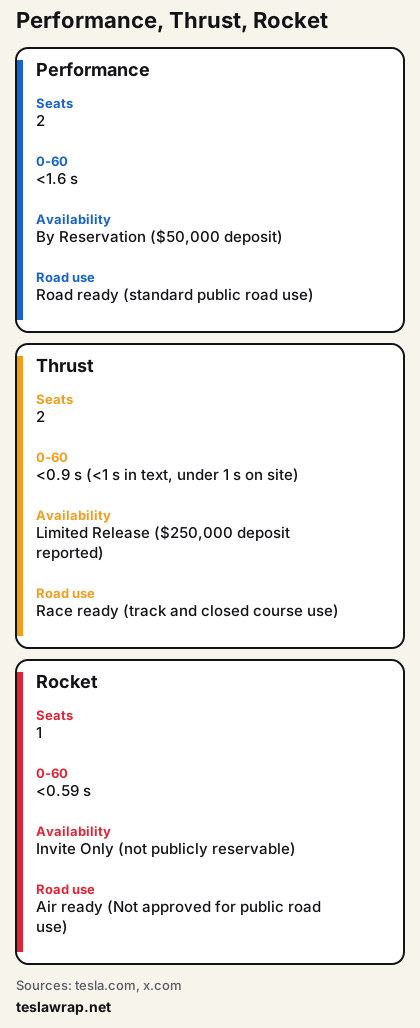
Tesla's updated product page divides the new Tesla Roadster 2 into three configurations: Performance, Thrust, and Rocket. The car capturing headlines is the Rocket trim. It is an air-ready package with cold-gas thrusters positioned around the perimeter. It eliminates the passenger seat for secondary high-pressure tanks, leaving room for one occupant. Tesla stamps this variant with an explicit disclaimer: Not approved for public road use. It is offered strictly invite-only. You cannot order it on the configurator.
Source: Tesla, Oct 16, 2026 (opens in a new tab) · Tesla, Oct 16, 2026 (opens in a new tab) · Decrypt, Oct 16, 2026 (opens in a new tab)
The car you can actually reserve through Tesla's website today is the Performance trim. This version seats two occupants and relies on road-based active aerodynamics and underbody fan suction. It has no thrusters and targets 0 to 60 mph in under 1.6 seconds, marked as road ready. Between them sits Thrust, a limited release under Tesla's Augments banner. Thrust adds rear thrusters for a sub-second 0 to 60 sprint while keeping two seats. Reports from Reuters and Wired indicate Thrust requires a $250,000 deposit.
Source: Tesla, Oct 16, 2026 (opens in a new tab) · Tesla, Oct 16, 2026 (opens in a new tab) · Reuters, Oct 15, 2026 (opens in a new tab) · WIRED, Oct 15, 2026 (opens in a new tab)
| Trim / Augment | Seating | Propulsion & Downforce | Target 0–60 mph | Availability | Road Legality |
|---|---|---|---|---|---|
| Performance | 2 seats | Active aero & multi-mode suction system (no thrusters) | <1.6 s | By Reservation ($50,000 deposit) | Road ready (standard road legal) |
| Thrust | 2 seats | Suction system + rear cold-gas thrusters | <0.9 s (<1 s in text, under 1 s on site) | Limited Release ($250,000 deposit reported) | Race ready (track/closed course) |
| Rocket | 1 seat | Suction system + perimeter cold-gas thrusters (flight capability) | <0.59 s | Invite Only | Air ready (Not approved for public road use) |
Source: Tesla, Oct 16, 2026 (opens in a new tab) · Tesla, Oct 16, 2026 (opens in a new tab) · Reuters, Oct 15, 2026 (opens in a new tab)
Elon's 2018 Sketch vs the 2026 Car
When Elon Musk posted a late-night tweet on June 9, 2018 proposing a SpaceX option package with roughly ten small rocket thrusters, the broader automotive world treated it like an absurd sci-fi fantasy. Musk cheekily mused that these rocket engines would dramatically improve acceleration, top speed, braking, and cornering, and might even allow a Tesla to fly. It took eight years and four months for that twenty-word sketch to materialize into metal and high-pressure nitrogen on a Texas launchpad. For long-time Tesla watchers, seeing an actual car lift off the tarmac at SpaceX McGregor felt like watching an internet meme graduate into serious aerospace hardware.
Source: Elon Musk, Jun 9, 2018 (opens in a new tab) · Tesla, Oct 16, 2026 (opens in a new tab)
Yet measuring that 2018 sketch against the October 2026 reveal highlights how the engineering and commercial concepts evolved during development. Musk originally pitched the hardware as an option package for a single standard car. Over eight years of prototyping, that add-on morphed into separate standalone trims, cold-gas thrusters became restricted to extreme non-street-legal builds, and primary cornering grip shifted to motorized underbody vacuum fans. Comparing each line of the 2018 tweet reveals what Tesla delivered, what altered course, and what remains unverified.
Source: Tesla, Oct 16, 2026 (opens in a new tab) · Hagerty, Oct 16, 2026 (opens in a new tab) · Jalopnik, Jun 7, 2021 (opens in a new tab)
| 2018 Tweet Promise | 2026 Reveal Reality | Verdict |
|---|---|---|
| Option package | Became separate trims/"augments": Thrust (limited release, rear-mounted thrusters) and Rocket (invite only, perimeter thrusters, not approved for public road use). | Changed |
| ~10 small rocket thrusters arranged seamlessly around car | Rocket: "perimeter-mounted cold-gas thrusters" (Tesla). Tesla's posts give no count; 4 rear + 6 more = 10 comes from Moravy via Hagerty/WIRED, TechCrunch says 10. | Delivered on Rocket only, count per interviews |
| Rocket thrusters/rocket engines | Cold-gas thrusters (compressed gas in COPVs, no combustion); 2021 Musk said compressed air (Jalopnik); Moravy says nitrogen at up to 10,000 psi (Hagerty). | Changed (technology refined) |
| Acceleration | Demo 0.81 s / 0.67 s with rollout subtracted (Tesla post); targets Thrust <0.9, Rocket <0.59. | Delivered (manufacturer-run demo, not independently tested) |
| Top speed | ">230 mph (Rocket)" officially; 2017 page promised over 250 mph; no official claim that thrusters raise top speed. | Unshown so far |
| Braking | Official 2026 claim absent. | Unconfirmed |
| Cornering | Cornering grip now comes mainly from the suction fans and active wings (Tesla); Rocket thrusters add "lateral rotational movement". | Changed |
| Maybe ... fly | "So...yes, it can fly" (Tesla configurations post), shown in Elon's Oct 16, 2026 video; Rocket only, invite only, not approved for public roads. | Delivered, with limits |
Source: Elon Musk, Jun 9, 2018 (opens in a new tab) · Tesla, Oct 16, 2026 (opens in a new tab) · Hagerty, Oct 16, 2026 (opens in a new tab) · WIRED, Oct 15, 2026 (opens in a new tab) · TechCrunch, Oct 15, 2026 (opens in a new tab) · Jalopnik, Jun 7, 2021 (opens in a new tab)
From Lotus Elise Roots to Spaceflight: Lineage and Evolution Across Two Decades
Tracing the Roadster lineage reveals how Tesla's engineering ethos has mutated over eighteen years. In March 2008, series assembly of the original Roadster began at a Lotus plant in Hethel, England. Workers mated lengthened Elise aluminum chassis to Californian battery packs. That pioneer cost $98,950, carried 6,831 laptop-style lithium cells, and delivered a 244-mile EPA range, hitting 60 mph in 3.7 seconds in Sport trim. Tesla retired it in early 2012 after roughly 2,450 units when Lotus contracts and federal airbag exemptions expired. It was an analog sports car with an electric heart, built to prove electric vehicles were desirable.
Source: AutoWeek, Mar 16, 2008 (opens in a new tab) · Hagerty, Oct 15, 2026 (opens in a new tab) · Wikipedia, Oct 17, 2026 (opens in a new tab) · Tesla, Oct 16, 2026 (opens in a new tab)
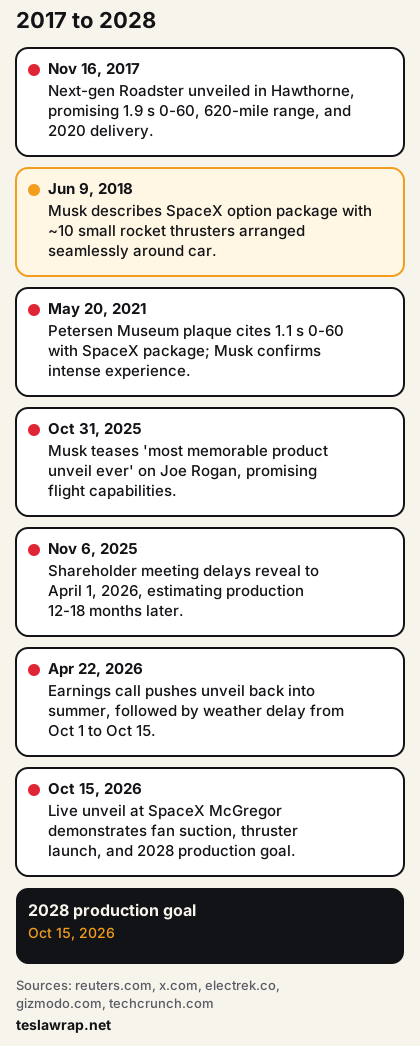
That original chassis achieved immortal fame on February 6, 2018, when Falcon Heavy launched Elon Musk's personal midnight cherry Roadster into deep space. Carrying the Starman mannequin, it entered a heliocentric solar orbit crossing Earth and Mars. Musk reminded followers after McGregor that his original car still orbits out there. Terrestrial ambitions followed a more turbulent path. On November 16, 2017, Franz von Holzhausen rolled a crimson prototype out of a Semi trailer in Hawthorne, California. Musk promised a four-seat, 620-mile, all-wheel-drive supercar for $200,000, promising customer deliveries by 2020.
Source: CBS News, Feb 7, 2018 (opens in a new tab) · Elon Musk, Oct 16, 2026 (opens in a new tab) · Reuters, Nov 17, 2017 (opens in a new tab) · Tesla Archive, Jun 24, 2018 (opens in a new tab)
What followed was an epic six-year chronicle of missed deadlines cataloged by EV outlets. Production slipped from 2020 through 2021, 2022, 2023, and 2024. In October 2025, Musk told Joe Rogan the reveal had a shot at being the most memorable product unveil ever. Weeks later, he moved the target to April Fool's Day 2026 for plausible deniability. Thruster testing at McGregor pushed the date into summer, until a September weather slip led to October 15, 2026. The resulting machine abandoned almost every mechanical premise of the 2017 concept.
Source: Electrek, Oct 14, 2026 (opens in a new tab) · Gizmodo, Oct 31, 2025 (opens in a new tab) · TechCrunch, Nov 6, 2025 (opens in a new tab) · Electrek, Apr 22, 2026 (opens in a new tab)
Sourced Tale of Two Specs: The 2017 Promises Versus 2026 Reality
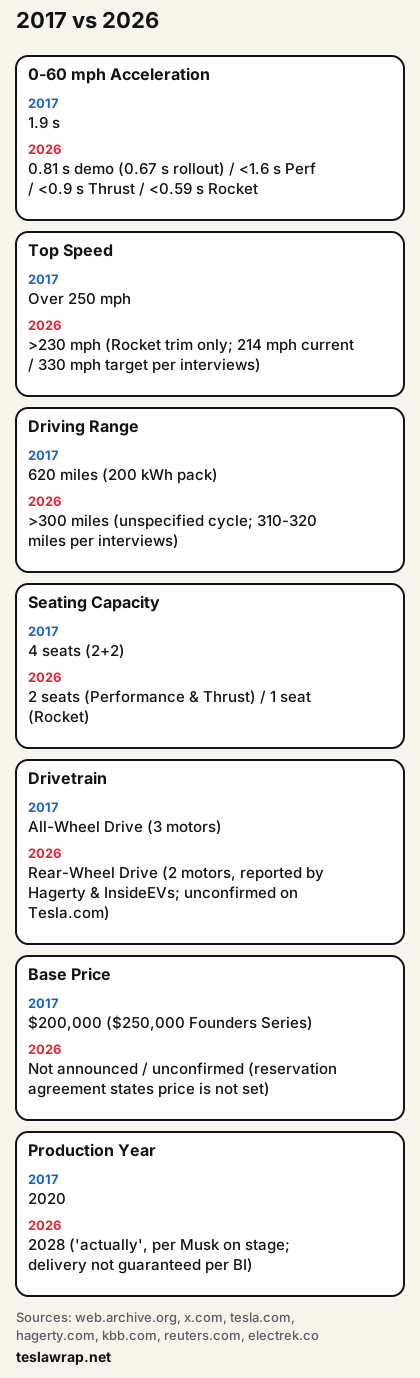
Placing the 2017 specification sheet alongside the 2026 reveal illustrates an extraordinary pivot. In 2017, Tesla framed the Roadster as a grand tourer with a 200 kWh battery pack and 620-mile range. The 2026 unveil discarded that marathon range, substituting an official claim of greater than 300 miles. In pre-reveal interviews filmed with Top Gear, Lars Moravy cited 310 to 320 miles in normal driving. Tesla shrank the pack to cut curb weight, trading long-distance cruising for explosive acceleration bursts.
Source: Tesla Archive, Jun 24, 2018 (opens in a new tab) · Tesla, Oct 16, 2026 (opens in a new tab) · InsideEVs, Oct 16, 2026 (opens in a new tab)
The mechanical architecture underwent an equally radical transformation. While the 2017 prototype featured three motors, all-wheel drive, and 2+2 seating, the 2026 car shifted to rear-wheel drive. It uses two motors with torque vectoring. Cabin capacity fell to two seats in Performance and Thrust, while Rocket sacrifices the passenger seat for gas tanks. Even top speed changed: the 2017 target of over 250 mph became up to greater than 230 mph, tagged strictly to Rocket. Meanwhile, purchase prices vanished from the configurator. Our side-by-side comparison chart below maps out these stark departures across each major metric.
Source: Hagerty, Oct 16, 2026 (opens in a new tab) · InsideEVs, Oct 16, 2026 (opens in a new tab) · Tesla, Oct 16, 2026 (opens in a new tab) · Kelley Blue Book, Oct 16, 2026 (opens in a new tab)
| Metric | 2017 Hawthorne Promise | 2026 Official Unveil (Tesla.com / X) | 2026 Executive Interviews (Hagerty / InsideEVs) |
|---|---|---|---|
| 0–60 mph Sprint | 1.9 s (base model) | 0.81 s demo (0.67 s rollout subtracted); <1.6 s (Perf), <0.9 s (Thrust), <0.59 s (Rocket) | 0.85 s (Thrust); 0.55 s rollout figure (Rocket) |
| Top Speed | Over 250 mph | Up to >230 mph (Rocket trim only); Mach 0.5 (~383 mph) stage wish | 214 mph current capability; 330 mph long-term engineering target |
| Driving Range | 620 miles (200 kWh battery pack) | >300 miles (unspecified test cycle) | Around 310 to 320 miles in normal driving |
| Seating Capacity | 4 seats (2+2 layout) | 2 seats (Performance & Thrust); 1 seat (Rocket) | 1 to 2 seats (Rocket passenger space holds second 400L tank) |
| Drivetrain & Motors | All-Wheel Drive (3 electric motors) | Unstated on official site / posts | Rear-Wheel Drive only (2 electric motors with torque vectoring) |
| Base Purchase Price | $200,000 ($250,000 Founders Series) | Unannounced / unconfirmed (agreement states price is estimate) | Unconfirmed (Tesla asked outlets to withhold pricing) |
| Production Year | 2020 | 2028 ('actually', stated by Musk on stage) | 2028 in Texas ('This one, we're going to build') |
Source: Tesla Archive, Jun 24, 2018 (opens in a new tab) · Tesla, Oct 16, 2026 (opens in a new tab) · Hagerty, Oct 16, 2026 (opens in a new tab) · InsideEVs, Oct 16, 2026 (opens in a new tab) · Reuters, Nov 17, 2017 (opens in a new tab) · Electrek, Oct 15, 2026 (opens in a new tab)
How to Read the Acceleration Numbers: 0.81 Seconds, Rollout, and Powertrain Confusions
Making sense of Tesla's performance claims requires decoding the drag-strip convention known as rollout. In American drag racing, timing beams do not trigger the clock until a vehicle rolls forward twelve inches off the line. Subtracting rollout artificially shaves two to three tenths of a second off acceleration, masking initial stationary inertia. When Tesla demonstrated the new Tesla Roadster at McGregor, the company posted a run of 0 to 60 mph in 0.81 seconds. Minutes later, Tesla posted a follow-up stating 0.67 seconds with rollout subtracted, revealing a 0.14-second difference.
Source: Tesla, Oct 16, 2026 (opens in a new tab) · Tesla, Oct 16, 2026 (opens in a new tab)
Executive interviews introduced separate performance figures that require careful untangling. On X, Tesla targets under 1.6 seconds for Performance, under 0.9 seconds for Thrust, and under 0.59 seconds for Rocket. Yet speaking to Hagerty, Lars Moravy stated Rocket achieves 0 to 60 in 0.55 seconds, calling it a rollout figure. These four numbers should never be merged. Tesla's demonstrated run was 0.81 seconds true time and 0.67 seconds with rollout subtracted. Meanwhile, under 0.59 seconds is an official engineering target, and 0.55 seconds is an executive interview projection using rollout math.
Source: Tesla, Oct 16, 2026 (opens in a new tab) · Hagerty, Oct 16, 2026 (opens in a new tab)
Conflicting figures similarly surround output and top speed. Official Tesla literature lists no horsepower or battery size. In interviews, Hagerty reported all variants generate over one megawatt, equating to 1,341 horsepower and 1,033 lb-ft of torque. InsideEVs cited an 800-plus kilowatt (1,073 horsepower) base configuration and 1,000-kilowatt higher trim, while MotorTrend's video description cited more than 1,500 horsepower. Stated top speed also fractures. Tesla posted up to greater than 230 mph strictly for Rocket. InsideEVs reported 214 mph currently with a 330 mph target, while Musk told the crowd he wants the car to crack half the speed of sound, roughly 383 mph.
Source: Tesla, Oct 16, 2026 (opens in a new tab) · Hagerty, Oct 16, 2026 (opens in a new tab) · InsideEVs, Oct 16, 2026 (opens in a new tab) · MotorTrend, Oct 16, 2026 (opens in a new tab) · Reuters, Oct 15, 2026 (opens in a new tab)
Even propellant descriptions diverge across reports. Official posts refer exclusively to compressed gas in pressure vessels. Lars Moravy explained to Hagerty that the system uses dry compressed nitrogen pressurized to 10,000 psi to deliver over 80 kilonewtons of thrust. By contrast, a recap by Not a Tesla App described the tanks as holding 250 kilograms of air and claimed the car recharges its own tanks. That self-recharge claim directly conflicts with Moravy's interview, where he explained external nitrogen refills currently require two to seven hours, with engineers targeting thirty minutes.
Source: Tesla, Oct 16, 2026 (opens in a new tab) · Hagerty, Oct 16, 2026 (opens in a new tab) · Oct 16, 2026, Not a Tesla App (opens in a new tab) · InsideEVs, Oct 16, 2026 (opens in a new tab)
Under the Skin: Inverted Suction Fans, Cold-Gas Thrusters, and Optimus Actuators
Stripping away conflicting numbers reveals genuine mechanical audacity. The powertrain incorporates cold-gas thrusters, which are compact rocket engines that generate thrust by venting pressurized gas through supersonic nozzles without combustion or flames. To store that energy, Tesla packed chassis voids with Carbon Fiber Overwrapped Pressure Vessels, or COPVs. These lightweight vessels feature structural liners wrapped in carbon fiber to hold gas at 10,000 psi safely. Tesla noted this pneumatic system exerts four to five times the tractive force of performance tire rubber.
Source: Tesla, Oct 16, 2026 (opens in a new tab) · Tesla, Oct 16, 2026 (opens in a new tab) · Hagerty, Oct 16, 2026 (opens in a new tab)
Equally unprecedented is Tesla's active vacuum fan downforce mechanism. Echoing historical fan cars like the Chaparral 2J and modern McMurtry Spéirling, motorized fans extract air beneath sealed skirts. This underbody vacuum creates massive downforce even when stationary, generating enough suction to hold the car upside down. InsideEVs reported Moravy claimed the system delivers up to 2 g of vertical hold. For high-speed balance, Tesla linked dynamic wings to electromechanical actuators from the Tesla Optimus humanoid robotics program, providing active stabilization approaching Formula 1 levels.
Source: Tesla, Oct 16, 2026 (opens in a new tab) · Tesla, Oct 16, 2026 (opens in a new tab) · InsideEVs, Oct 15, 2026 (opens in a new tab)
Public Roads, the FAA Question, and Third-Party Reality Checks
Translating aerospace stunts into street-legal transportation presents immense regulatory hurdles. Tesla's product page marks the flying Rocket trim as not approved for public road use. When audience members at McGregor questioned legality, Musk acknowledged ambiguity, replying that legality depends on your street and adding that this is not necessarily a safety-optimized car. Tech outlet Decrypt pointed out that certifying a novel roadable aircraft with the Federal Aviation Administration typically spans five to nine years. To date, no FAA aircraft type certificate or NHTSA safety filing exists for the vehicle.
Source: Tesla, Oct 16, 2026 (opens in a new tab) · Car and Driver, Oct 16, 2026 (opens in a new tab) · InsideEVs, Oct 16, 2026 (opens in a new tab) · Decrypt, Oct 16, 2026 (opens in a new tab)
Automotive journalists responded with disciplined skepticism. In Electrek's Take, editor Fred Lambert acknowledged the engineering is genuine, but cautioned that headline stunts belong to experimental trims barred from public roads, doubting Tesla will build more than a handful. An analysis in The Verge argued that calling a machine packed with 600 liters of high-pressure gas a consumer car stretches credibility, noting the McMurtry Spéirling's 1.35-second benchmark stands until independent testing occurs. In Wired, Aarian Marshall noted over 80 kilonewtons of thrust matches a Falcon 10X jet engine, while calculating that unfulfilled $50,000 deposits from 2017 are worth over $68,000 today.
Source: Electrek, Oct 15, 2026 (opens in a new tab) · The Verge, Oct 16, 2026 (opens in a new tab) · WIRED, Oct 15, 2026 (opens in a new tab) · WIRED, Oct 16, 2026 (opens in a new tab)
Financial and consumer outlets added further caution. Business Insider urged buyers to examine fine print showing reservation terms do not guarantee delivery. Wire service Reuters noted that 2028 production lands more than a decade after the Hawthorne showing, citing observer speculation that the theatrical demo served as promotion for a Tesla and SpaceX merger. Hagerty stressed that claiming to conquer circuit records remains unproven, while Kelley Blue Book highlighted that the flight demo operated without a human inside, reiterating that pricing, battery capacity, and delivery dates remain unconfirmed.
Source: Business Insider, Oct 16, 2026 (opens in a new tab) · Reuters, Oct 15, 2026 (opens in a new tab) · Hagerty, Oct 15, 2026 (opens in a new tab) · Kelley Blue Book, Oct 16, 2026 (opens in a new tab)
Enthusiasts reacted across social media with astonishment and humor. On X, Elon Musk's 15-second flight clip gained 58 million views. Google CEO Sundar Pichai posted a playful reply imagining a Full Self-Driving aerial variant. A ubiquitous meme celebrated that society received flying cars before Grand Theft Auto VI. Shopify chief executive Tobi Lutke questioned unconfirmed fan simulations predicting record Circuit of the Americas lap times. On Reddit's r/teslamotors, users relied on spectator smartphone footage to verify the stunt was not computer-generated, joking whether discharging cold gas represents an electric version of rolling coal.
Source: Elon Musk, Oct 16, 2026 (opens in a new tab) · Sundar Pichai, Oct 16, 2026 (opens in a new tab) · X, Oct 16, 2026 (opens in a new tab) · Tobi Lutke, Oct 16, 2026 (opens in a new tab) · Reddit r/teslamotors, Oct 16, 2026 (opens in a new tab) · Reddit r/teslamotors, Oct 16, 2026 (opens in a new tab)
In skeptical forums like Reddit's r/RealTesla, commentators questioned practical road usage. Users asked where owners could ever discharge high-pressure gas safely, dismissing Mach 0.5 rhetoric after years of missed timelines. On r/cars, discussion centered on the nine-year wait since 2017, with enthusiasts quipping that Rocket appeared reserved for executives and influencers. Across community threads, the prevailing sentiment converged on a pragmatic verdict: enthusiasm for the engineering must be paired with patience until verified customer deliveries materialize.
Source: Reddit r/RealTesla, Oct 16, 2026 (opens in a new tab) · Reddit r/cars, Oct 16, 2026 (opens in a new tab)
What Your $50,000 Reservation Buys: The Agreement Checklist and the Long Wait for 2028
Reserving on Tesla's website today commits substantial capital without locking in specifications, delivery timelines, or the final Tesla Roadster price. The legal agreement explicitly notes that vehicle features and hardware remain subject to development. For early adopters holding reservations from 2017, Tesla's digital infrastructure provides no stated conversion mechanism or verified queue priority.
Source: Tesla, Oct 17, 2026 (opens in a new tab) · Tesla, Oct 15, 2026 (opens in a new tab) · Business Insider, Oct 16, 2026 (opens in a new tab)
- 1
Initial Deposit Due Today
You submit a $5,000 credit card transaction immediately upon reserving, which Tesla's terms classify as fully refundable.
- 2
Wire Transfer Within 10 Days
You must wire an additional $45,000 balance within 10 days, or Tesla reserves the right to cancel your reservation.
- 3
Estimated Purchase Price
The reservation terms explicitly state that any purchase price is an estimate because options, features, and hardware are still being developed.
- 4
Approximate Priority Only
Placing a reservation does not constitute a vehicle order or purchase contract, merely establishing approximate queue priority.
- 5
Delivery Unguaranteed
As Business Insider identified in the terms, the vehicle remains under active development and Tesla cannot guarantee when or if delivery will occur.
- 6
2017 Priority Unconfirmed
Official documentation does not confirm whether depositors who paid $50,000 or $250,000 in 2017 retain first-batch delivery priority.
- 7
2028 Production Target
Production is targeted for 2028 per Musk on stage (reported by Electrek, Reuters, and Car and Driver), but delivery dates are not guaranteed in the reservation terms as reported by Business Insider.
While you wait for aerospace engineering to reach assembly lines in 2028, you can upgrade the vehicle sitting in your driveway right now. Drivers eager to refresh their Model 3, Model Y, Model S, or Cybertruck can explore creative ideas across the TeslaWrap community. You can browse the free Tesla wrap gallery for real-world color inspiration or experiment with custom digital concepts using the TeslaWrap AI wrap designer before booking installation with a vinyl specialist.
YouTube · Oct 16, 2026Roadster Event LivestreamTesla's official 30-minute broadcast of the live unveil presentation at SpaceX McGregor. (opens in a new tab)YouTube · Oct 16, 2026The FLYING Tesla Roadster explained by the man who engineered itHagerty's technical walkthrough interview with Tesla Vice President of Vehicle Engineering Lars Moravy. (opens in a new tab)